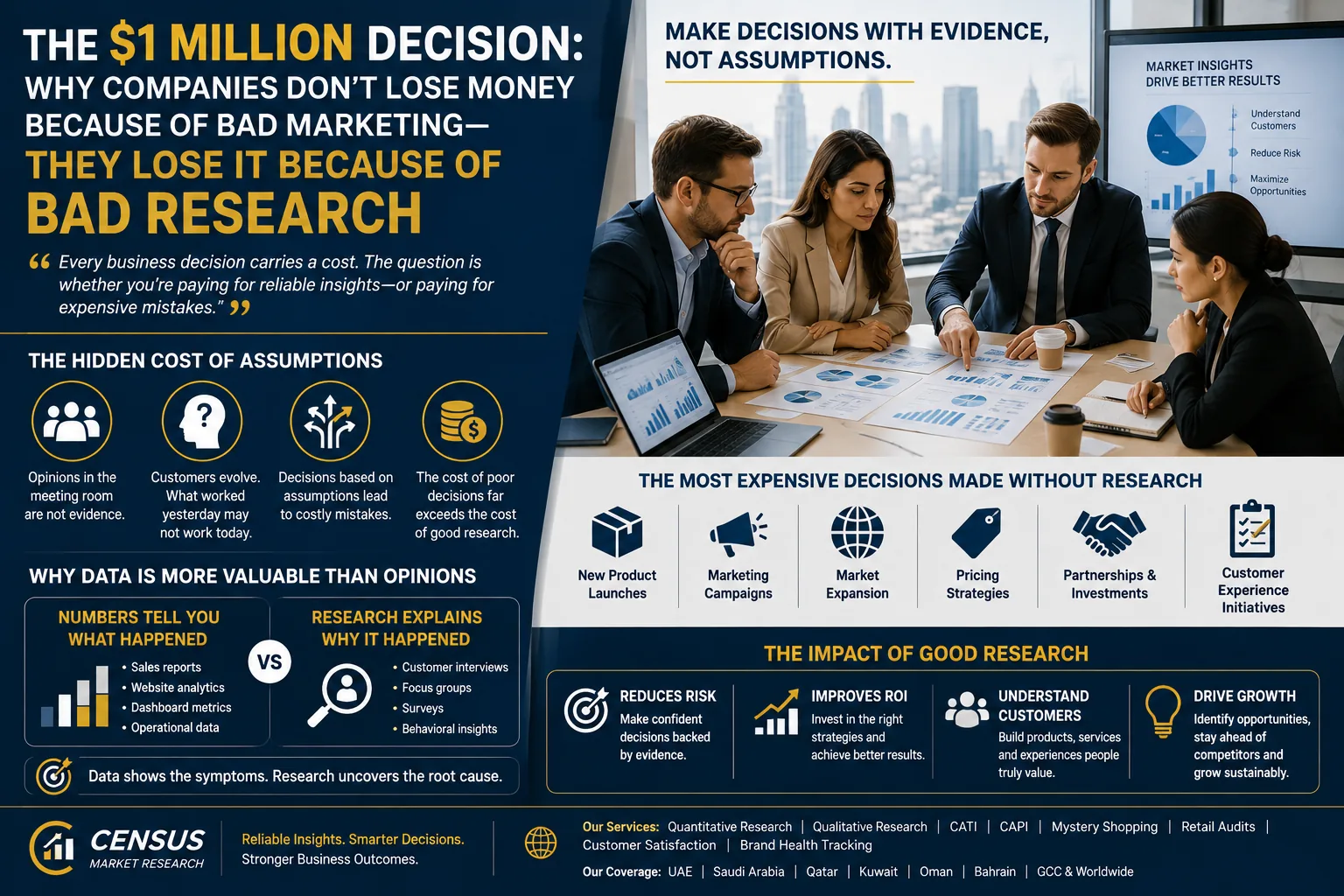
The $1 Million Decision: Why Companies Don't Lose Money Because of Bad Marketing—They Lose It Because of Bad Research
"Every business decision carries a cost. The question is whether you're paying for reliable insights—or paying for expensive mistakes."
Introduction
Every year, businesses around the world invest billions of dollars in marketing campaigns, product launches, digital transformation initiatives, customer experience programs, and expansion strategies. Yet despite these investments, many projects fail to deliver the expected results.
When organizations look for the reason, marketing often receives the blame.
The advertising campaign wasn't strong enough.
The sales team didn't execute properly.
The pricing strategy was wrong.
The competition reacted faster.
While these factors can contribute to disappointing outcomes, they are often symptoms rather than the root cause.
In reality, many costly business failures begin long before the first advertisement is published, the first salesperson makes a call, or the first product reaches customers.
They begin when decisions are made without reliable market intelligence.
Market research is not simply a tool for collecting opinions. It is the process that reduces uncertainty before significant investments are made. It helps organizations understand customer needs, evaluate demand, identify risks, test assumptions, and make evidence-based decisions instead of relying on instinct.
In today's competitive business environment, the difference between a successful investment and an expensive lesson often comes down to one question:
Did the decision rely on evidence—or assumption?
Companies that consistently outperform their competitors rarely make strategic decisions based solely on internal opinions. They invest in understanding their customers, markets, and competitive landscape before committing substantial budgets.
Organizations that skip this process may appear to save money initially, but the long-term cost of poor decisions often far exceeds the cost of conducting professional research.
This article explores why market research has become one of the most valuable strategic investments for modern businesses and how reliable customer insights help organizations minimize risk while maximizing opportunity.
The Hidden Cost of Assumptions
Every executive has experienced it.
A meeting room filled with experienced professionals.
Marketing believes customers want Feature A.
Sales insists customers prefer Feature B.
Finance recommends reducing prices.
Operations argues for expanding into a new market.
Each opinion is supported by experience, confidence, and conviction.
Yet confidence is not evidence.
Business history is filled with examples of organizations that made logical decisions based on internal consensus only to discover that customers thought differently.
The challenge is not that leaders lack expertise.
The challenge is that customers continuously evolve.
Consumer expectations change.
Technology changes.
Economic conditions change.
Competitive landscapes change.
Cultural trends change.
What worked two years ago may no longer be relevant today.
Without current market intelligence, even highly experienced leadership teams risk making decisions based on outdated assumptions.
This is where professional market research changes the conversation.
Instead of asking:
"What do we think customers want?"
Organizations begin asking:
"What does the evidence show?"
That single shift in mindset transforms decision-making across the business.
Why Data Is More Valuable Than Opinions
One of the biggest misconceptions in business is that collecting large amounts of data automatically leads to better decisions.
It doesn't.
Raw data is only valuable when it answers meaningful business questions.
Companies today have access to unprecedented volumes of information:
- Website analytics
- CRM data
- Social media metrics
- Sales reports
- Customer service tickets
- Online reviews
- Advertising performance
- Mobile application analytics
These resources provide valuable operational insights.
However, they rarely explain why customers behave the way they do.
For example:
A dashboard may show declining sales.
Market research explains why customers stopped buying.
Website analytics may reveal that visitors abandon a product page.
Customer interviews reveal what prevented them from completing the purchase.
Sales reports indicate which products are underperforming.
Qualitative research uncovers the emotional, practical, or competitive factors influencing those purchasing decisions.
This distinction is critical.
Numbers tell organizations what happened.
Professional research explains why it happened.
That difference often determines whether the next strategic decision succeeds.
The Most Expensive Business Decisions Are Usually Made Without Customer Evidence
Organizations frequently invest substantial budgets in decisions such as:
- Launching new products
- Entering new markets
- Opening retail locations
- Rebranding
- Increasing advertising budgets
- Changing pricing strategies
- Expanding distribution channels
- Developing digital platforms
Each of these decisions may involve hundreds of thousands—or even millions—of dollars.
Ironically, some businesses hesitate to invest a small percentage of that budget in validating customer demand before moving forward.
Imagine investing USD 2 million in launching a new product without first understanding whether customers actually perceive value in it.
Or expanding into a new country without researching local buying behaviors, cultural preferences, competitive dynamics, and pricing expectations.
These scenarios are more common than many executives realize.
Professional market research does not eliminate every business risk.
However, it dramatically improves the quality of the information available before critical decisions are made.
In many cases, discovering a weakness before launch saves significantly more money than correcting mistakes after implementation.
The question is no longer whether businesses can afford market research.
The better question is:
Can they afford to make strategic decisions without it?
Why the Best CEOs Don't Ask "What Happened?"—They Ask "What Happens Next?"
One of the biggest differences between average companies and industry leaders is not budget, technology, or company size.
It is how they make decisions.
Many organizations use market research only after something has gone wrong.
Sales decline.
Customers complain.
A competitor gains market share.
A product launch underperforms.
Only then does the company commission research to understand the problem.
Leading organizations take the opposite approach.
They use research before making important decisions.
Instead of reacting to problems, they reduce the likelihood of creating them in the first place.
This shift changes the role of market research from being a reporting tool to becoming a strategic decision-making tool.
The most successful CEOs rarely ask:
"What happened?"
Instead, they ask:
- What risks are we not seeing?
- What assumptions are we making?
- What evidence supports this decision?
- What will customers think six months from now?
- What does the market expect next?
These questions are not about collecting more data.
They are about making better decisions.
The Census Decision Confidence Framework™
At Census Market Research, we believe every important business decision should pass through five stages before significant investment is made.
We call this the Decision Confidence Framework™.
Rather than relying on assumptions or internal opinions, the framework helps organizations validate decisions with evidence at every step.
Stage 1: Understand the Market
Before launching a product, entering a new country, or changing a strategy, ask:
- Is there genuine demand?
- How large is the opportunity?
- What are customers already buying?
- Who are the strongest competitors?
- Is the market growing or shrinking?
Many businesses skip this stage because they assume they already know the answers.
Professional research often reveals opportunities—and risks—that internal teams haven't considered.
Stage 2: Understand the Customer
Businesses frequently describe their customers using demographics alone.
Age.
Income.
Gender.
Location.
However, demographics explain who the customer is.
They rarely explain why customers make purchasing decisions.
Modern market research focuses on deeper questions.
- What motivates customers?
- What problems are they trying to solve?
- What frustrations influence purchasing?
- Which brands do they trust?
- What prevents them from buying?
Understanding customer psychology often creates a much stronger competitive advantage than understanding demographics.
Stage 3: Test Before Investing
One of the most valuable uses of research is preventing expensive mistakes before they happen.
Instead of asking customers after launch whether they like a product...
Ask them before launch.
Businesses can test:
- Product concepts
- Pricing
- Packaging
- Brand names
- Advertising campaigns
- Customer journeys
- Digital experiences
- Store layouts
- New service ideas
Testing before investing usually costs only a fraction of correcting mistakes afterward.
Stage 4: Measure Reality
Once a product or campaign launches, assumptions should stop.
Evidence should begin.
Research helps organizations measure:
- Customer satisfaction
- Brand awareness
- Purchase intent
- Market penetration
- Loyalty
- Net Promoter Score (NPS)
- Customer experience
- Competitive positioning
Continuous measurement enables companies to adapt quickly rather than waiting until performance declines.
Stage 5: Improve Continuously
Markets never remain static.
Consumer expectations evolve.
Technology changes.
Economic conditions shift.
Competitors innovate.
The organizations that continue learning continue growing.
The organizations that stop listening eventually fall behind.
Market research should therefore become an ongoing strategic capability—not a one-time project.
Five Multi-Million-Dollar Mistakes That Better Research Can Prevent
1. Launching Products Nobody Actually Wants
Many organizations believe customers will automatically appreciate new features.
Unfortunately, customers rarely purchase products because companies believe they are innovative.
They purchase products because those products solve meaningful problems.
A successful launch begins with understanding customer needs—not internal enthusiasm.
2. Expanding Into Markets Based on Assumptions
International expansion often appears attractive on paper.
Strong GDP.
Large population.
Growing economy.
However, market size alone does not guarantee opportunity.
Consumer behavior differs dramatically between countries.
Buying habits.
Payment preferences.
Brand expectations.
Language.
Culture.
Distribution channels.
Without local market intelligence, expansion becomes considerably more risky.
This is particularly important across the GCC, where each market has distinct characteristics despite geographical proximity.
3. Competing Only on Price
When businesses don't fully understand customer value, they often reduce prices.
Price reductions may increase short-term sales.
However, they can also reduce margins while damaging brand perception.
Research frequently reveals that customers care more about:
- Convenience
- Trust
- Quality
- Availability
- Service
- Brand reputation
- Speed
- Simplicity
Understanding value perception often produces stronger long-term growth than competing solely on price.
4. Building Products for Internal Teams Instead of Customers
One of the most common business mistakes occurs when companies design products around internal preferences.
Executives like it.
Engineers like it.
Marketing likes it.
Sales likes it.
But customers remain indifferent.
Customer-centered development begins by involving customers early—not after the final version has already been completed.
5. Measuring Success Using Internal Metrics Alone
Businesses naturally monitor revenue.
Profit.
Costs.
Efficiency.
Productivity.
These indicators matter.
However, they describe business performance—not customer perception.
Customer perception ultimately determines long-term success.
Market research bridges this gap by measuring what financial reports cannot.
Why GCC Markets Require Local Research Expertise
The Gulf region is one of the world's most dynamic business environments.
Rapid economic diversification.
Digital transformation.
Population growth.
Tourism expansion.
International investment.
Government innovation initiatives.
These developments create exceptional opportunities.
They also increase market complexity.
Although the UAE, Saudi Arabia, Qatar, Kuwait, Oman, and Bahrain share regional similarities, consumer expectations differ across each market.
Language preferences.
Shopping habits.
Brand loyalty.
Digital adoption.
Payment behavior.
Retail environments.
Cultural influences.
Successful organizations recognize these differences.
Rather than applying one strategy across every market, they invest in localized customer understanding.
This is where experienced fieldwork partners become essential.
Accurate data collection.
Representative sampling.
Professional recruitment.
Multilingual interviewing.
Quality control.
These elements determine whether research becomes a reliable decision-making tool or simply another report.
AI Is Transforming Market Research—But It Cannot Replace Human Understanding
Artificial Intelligence has become one of the most influential technologies in modern business. It can summarize reports, identify trends, process large datasets, predict demand, and automate repetitive tasks in seconds.
For market researchers, AI is a powerful accelerator.
However, there is one thing AI still cannot do.
It cannot genuinely understand human emotion, context, or motivation without reliable human data.
AI is only as intelligent as the information it receives.
If the underlying data is incomplete, biased, outdated, or inaccurate, the conclusions generated by AI can also be misleading.
This is why professional market research has become even more valuable in the age of AI.
Businesses no longer need more data.
They need better data.
Imagine asking an AI system why a new product failed.
Without customer interviews, focus groups, surveys, or observational research, the AI can only make educated guesses based on existing patterns.
Now imagine providing the same AI system with thousands of verified customer responses collected through high-quality fieldwork.
The insights become significantly more reliable because they are grounded in real customer experiences.
The future does not belong to AI alone.
It belongs to organizations that combine AI with trustworthy market intelligence.
Market Research Is Not a Cost—It Is Risk Management
When executives evaluate budgets, market research is sometimes viewed as an expense.
In reality, it is better understood as a form of business insurance.
Every strategic decision involves uncertainty.
Should we launch this product?
Should we increase prices?
Should we expand into a new country?
Should we target a different customer segment?
Should we redesign our brand?
Each decision carries financial risk.
Professional research reduces that uncertainty by replacing assumptions with evidence.
The objective is not to guarantee success.
No research can promise that.
The objective is to increase confidence that decisions are based on facts rather than opinions.
In many organizations, preventing one poor investment can save far more than the entire annual research budget.
That is why experienced executives rarely ask,
"How much does market research cost?"
Instead, they ask,
"How much could a wrong decision cost us?"
What the World's Best Companies Have in Common
Across industries, successful organizations consistently demonstrate one important habit.
They listen before they act.
Whether launching new products, improving customer experience, entering new markets, or refining brand positioning, they invest time in understanding their customers.
They recognize that business success is not created inside meeting rooms.
It is created by solving real customer problems.
This philosophy applies equally to multinational corporations, regional businesses, and growing startups.
The scale may differ.
The principle remains the same.
Organizations that continuously learn from customers are better positioned to adapt, innovate, and grow.
Questions Every CEO Should Ask Before Approving a Major Investment
Before approving any significant business initiative, leadership teams should pause and ask:
-
What evidence supports this decision?
-
Have we validated customer demand?
-
Are we solving a genuine customer problem?
-
Have we tested this concept with our target audience?
-
What assumptions are we making?
-
How confident are we in our data?
-
What risks remain unknown?
-
How will success be measured?
-
What have customers actually told us?
-
What information would increase our confidence before investing?
These questions encourage disciplined decision-making and help organizations avoid costly assumptions.
Why High-Quality Fieldwork Matters
Even the best research design can fail if the data collection process is weak.
Reliable insights begin with reliable fieldwork.
Professional fieldwork involves much more than asking questions.
It requires:
-
Careful participant recruitment
-
Representative sampling
-
Well-trained interviewers
-
Cultural and language expertise
-
Strong quality-control procedures
-
Accurate data validation
-
Ethical research practices
-
Transparent reporting
When these elements work together, organizations gain confidence that their decisions are supported by dependable evidence.
At Census Market Research, we believe that data quality is the foundation of every successful research project.
Our approach combines experienced field teams, robust quality controls, and localized expertise across the GCC to help clients collect insights they can trust.
Final Thoughts
Business leaders will always face uncertainty.
Markets evolve.
Customer expectations change.
Competitors innovate.
Technology advances.
No company can eliminate risk entirely.
However, every organization can improve the quality of its decisions.
The most successful businesses are not necessarily those with the largest budgets.
They are often the businesses that understand their customers better than anyone else.
Market research is more than collecting responses.
It is about understanding people.
It transforms uncertainty into informed action.
It helps organizations identify opportunities before competitors do.
It reduces unnecessary risk.
It strengthens customer relationships.
Most importantly, it enables leaders to make decisions with confidence.
The next time your organization considers launching a product, entering a new market, redesigning a customer experience, or making a significant investment, ask one simple question:
Are we making this decision based on evidence—or assumption?
The answer may determine the success of your next million-dollar decision.
About Census Market Research
Census Market Research is a full-service market research and fieldwork agency serving organizations across the GCC and international markets. We support quantitative and qualitative research, CATI, CAPI, CAWI, focus groups, in-depth interviews, mystery shopping, customer satisfaction studies, brand tracking, retail audits, healthcare research, B2B research, and bespoke fieldwork solutions.
Our mission is simple:
To help organizations make smarter business decisions through reliable, high-quality market intelligence.
If your organization is planning a research project in the UAE, Saudi Arabia, Qatar, Kuwait, Oman, Bahrain, or other international markets, our team is ready to support your objectives with professional fieldwork and actionable insights.
Frequently Asked Questions (FAQs)
1. Why is market research important before launching a new product?
It helps validate customer demand, identify potential risks, refine product concepts, and improve the likelihood of a successful launch.
2. What is the difference between quantitative and qualitative research?
Quantitative research measures patterns using structured data, while qualitative research explores motivations, opinions, and behaviors through discussions and interviews.
3. How can market research reduce business risk?
By providing evidence about customer needs, competitor activity, pricing, and market demand before major investments are made.
4. Is market research useful for small and medium-sized businesses?
Yes. Businesses of every size benefit from understanding customers before investing in new products, services, or expansion.
5. How often should businesses conduct market research?
Many organizations conduct ongoing tracking studies, while others perform research before major strategic decisions.
6. Can AI replace market research?
AI enhances analysis but still depends on reliable, high-quality customer data gathered through professional research.
7. What industries benefit from market research?
Retail, healthcare, automotive, banking, tourism, real estate, telecommunications, FMCG, education, government, and technology all benefit from customer insights.
8. What is CATI research?
CATI (Computer-Assisted Telephone Interviewing) is a structured telephone survey method used for efficient and high-quality data collection.
9. What is CAPI research?
CAPI (Computer-Assisted Personal Interviewing) uses tablets or digital devices to collect face-to-face survey responses accurately.
10. What are focus groups?
Focus groups bring together carefully selected participants to discuss products, services, or ideas, helping businesses understand deeper opinions and emotions.
11. How long does a typical market research project take?
The timeline depends on the methodology, target audience, sample size, and geographic coverage. Projects can range from a few days to several weeks.
12. Why is local fieldwork expertise important in the GCC?
Local expertise improves participant recruitment, cultural understanding, language accuracy, and data quality across different markets.
13. What should businesses look for when choosing a research partner?
Experience, quality-control processes, industry knowledge, transparent reporting, representative sampling, and proven fieldwork capabilities.
14. How can research improve customer experience?
Research identifies customer expectations, pain points, satisfaction levels, and opportunities to enhance every stage of the customer journey.
15. How can Census Market Research help my business?
We work with organizations to design and execute reliable research projects that provide actionable insights, helping clients reduce uncertainty and make informed strategic decisions.
Every successful business invests in growth. The smartest businesses invest in understanding their customers before they invest in growth.
Discover why successful companies invest in market research before making major business decisions. Learn how customer insights reduce risk, improve ROI, and drive sustainable growth with Census Market Research.
