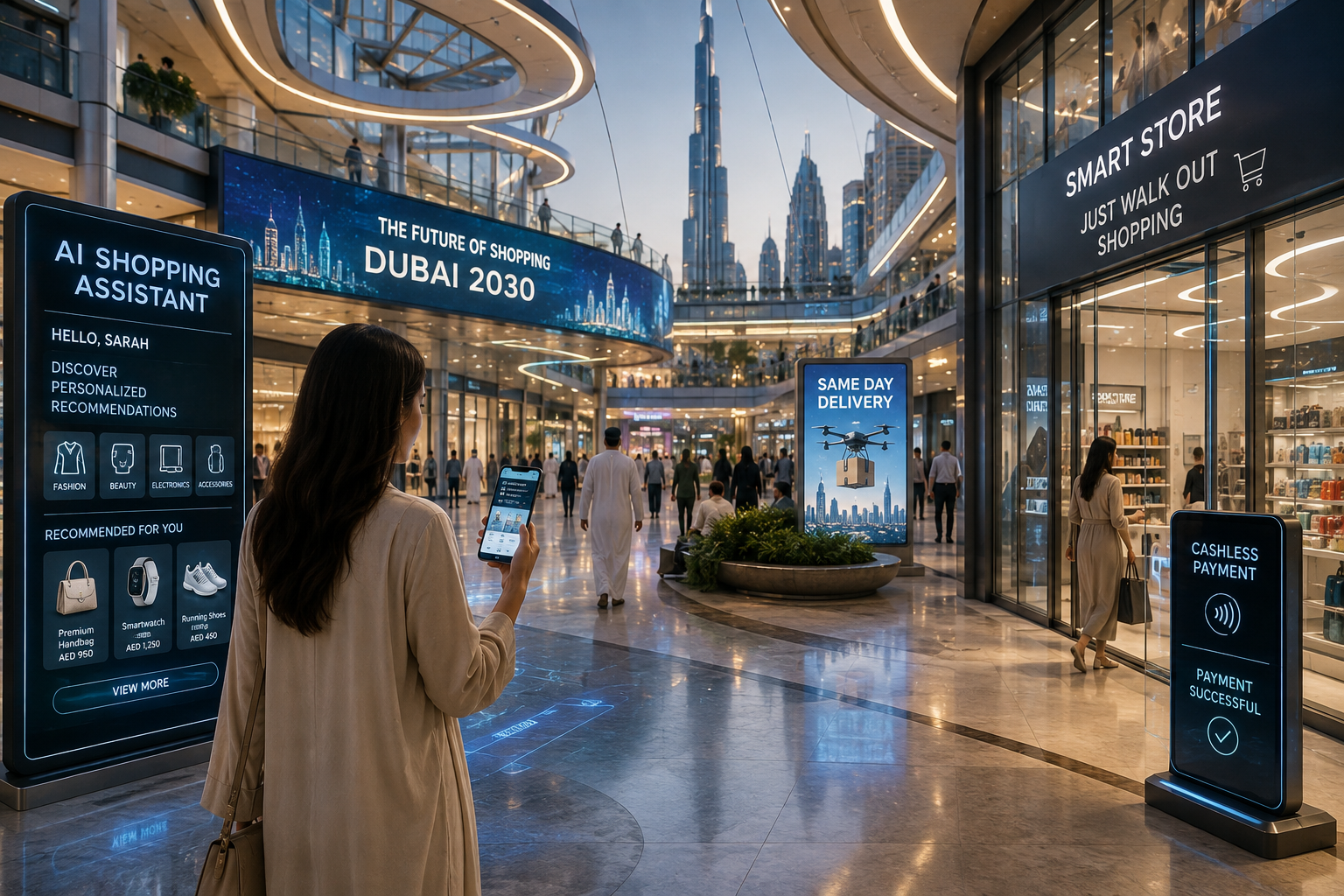
Imagine Shopping in Dubai in 2030
Imagine walking into a shopping mall in Dubai in 2030.
Your phone already knows which stores you normally visit. An AI shopping assistant has compared products before you arrive. Retailers can present offers based on your preferences, and if the product you want is unavailable in your size or colour, it could be delivered to your home later the same day.
Or perhaps you never visit the mall at all.
Within seconds, the system could compare products, prices, reviews and availability before presenting a shortlist.
This may sound futuristic, but many of the technologies needed to create this type of shopping experience already exist.
How Will Consumers Respond to It?
The more interesting question is not simply whether retail technology will continue to develop.
One Shopping Journey, Many Connected Touchpoints
Dubai has long been known for major shopping destinations, luxury retail, international brands and rapidly evolving digital services.
Today, physical retail, e-commerce, mobile payments and personalized digital experiences are increasingly becoming part of the same consumer journey.
Social media, search, advertising and AI recommendations.
Products, prices, reviews, features and availability.
Physical stores, malls, apps and digital platforms.
In-store, mobile, online or through an AI assistant.
Store collection, home delivery or rapid fulfilment.
The Future May Not Be Online vs Offline
The future of shopping in Dubai may not be about choosing between e-commerce and physical retail.
Instead, consumers may expect one connected experience combining stores, digital platforms, artificial intelligence, payments, fulfilment and personalized service.
The Consumer Questions Behind the Technology
These changes create an interesting opportunity for consumer research in Dubai .
Retailers can introduce new technology, but consumers ultimately determine which innovations become useful parts of the shopping experience.
Consumers may question whether recommendations genuinely reflect their needs or simply promote particular products.
There is a significant difference between receiving recommendations and allowing technology to make purchasing decisions on your behalf.
Greater personalization may require consumers to exchange more information about their preferences and behaviour.
Faster search, easier purchasing and rapid delivery may increasingly influence retailer choice.
As routine shopping interactions become automated, knowledgeable human assistance could become a more differentiated part of the experience.
The answer may depend less on physical versus digital channels and more on which journey feels easiest.
Convenience vs Privacy
One of the most important questions in future retail may be how much personal information consumers are willing to exchange for a more convenient and personalized experience.
More Convenience
- Personalized recommendations
- Faster product discovery
- Relevant offers
- Better availability information
- Faster checkout
- More convenient delivery
More Personal Data
- Shopping history
- Product preferences
- Location information
- Browsing behaviour
- Purchase patterns
- Personal interests
The future of personalization may depend on whether consumers believe the value they receive is worth the information they share.
Could Human Customer Service Become More Valuable?
It is easy to assume that greater automation will make human interaction less important.
The opposite could also happen.
Consumers may increasingly rely on technology for product comparison, availability checks, payments and delivery, while turning to employees when they need expertise, reassurance, problem-solving or personal advice.
This could make the quality of human interaction an even stronger differentiator for premium retailers, luxury brands and complex product categories.
What Should Retailers and Brands Be Measuring?
For retailers, shopping malls, e-commerce platforms and global brands operating in the UAE, understanding changing consumer expectations could become increasingly important.
Do consumers trust automated recommendations?
Which forms of personalization actually improve the experience?
What information are shoppers comfortable sharing?
When do consumers prefer stores, apps or websites?
How strongly do speed and simplicity influence retailer choice?
Where does personal interaction still add meaningful value?
Technology Alone Will Not Define the Future of Retail
At Census Market Research , we believe the future of retail will not be determined by technology alone.
It will depend on which innovations genuinely improve the consumer experience and which ones shoppers actually choose to adopt.
Through retail and consumer market research in the UAE , qualitative research, quantitative surveys, customer-experience studies and mystery shopping, businesses can better understand how expectations are changing as physical and digital shopping become increasingly connected.
The future of retail will not be defined by technology alone, but by how consumers choose to experience it.
AI Could Become Your Personal Shopper
One of the biggest changes in retail may happen before consumers even enter a store.
Today, a shopping journey might begin with Google, social media, an online marketplace, a retailer's website or a recommendation from a friend.
By 2030, that starting point could increasingly become an AI assistant.
“I need a birthday gift for a colleague. My budget is AED 300. She enjoys fitness and travelling. Show me the best options available in Dubai today.”
An AI assistant could compare products, prices, reviews, availability and delivery options before presenting a shortlist.
This could fundamentally change the way brands compete.
What happens when technology starts influencing the purchase before the consumer even sees the brand?
Understanding how much consumers trust AI recommendations, which categories they are comfortable using them for and when they still prefer human advice could become an important area of quantitative research in the UAE .
Would Consumers Let AI Actually Buy for Them?
There is a significant difference between allowing AI to help make a decision and allowing AI to make the decision.
A consumer may be comfortable asking an AI assistant to compare television specifications, summarize product reviews or find the cheapest flight.
But would that same person allow AI to complete the purchase automatically?
The level of trust is unlikely to be identical across categories.
The Traditional Checkout Could Gradually Disappear
Think about one of the least enjoyable parts of shopping:
WAITING IN A QUEUE.Retail technology is increasingly designed to remove friction from the purchasing journey.
In the future, more stores may allow consumers to enter, select their products and leave without going through a conventional checkout process.
Payment could happen automatically in the background.
For consumers, this offers obvious convenience.
But it also creates new questions:
How much personal data will consumers exchange for greater convenience?
These questions make customer experience research increasingly important as retailers introduce new technologies.
Cash Could Become Even Less Visible
Dubai and the wider UAE have already experienced rapid adoption of cards, mobile wallets and digital payments.
By 2030, the act of paying could become even less noticeable.
When payment becomes almost invisible, does consumer spending behaviour change?
Removing friction can improve convenience, but retailers also need to understand how consumers perceive security, transparency and control.
This is where consumer behaviour research becomes particularly valuable.
Personalization Could Become Extremely Personal
Retail personalization already exists. Consumers receive recommendations based on previous purchases, browsing behaviour and loyalty-programme activity.
But the next generation of personalization could become considerably more sophisticated.
Promotions, discounts and practical recommendations.
Luxury products, exclusivity and personalized recommendations.
Two consumers entering the same digital or physical store could effectively experience two different versions of that store.
That boundary will not necessarily be the same for every consumer.
Understanding it will require more than technology. It will require qualitative research that explores how consumers actually feel about personalization, privacy and data sharing.
The Dubai Mall Experience May Become More Important, Not Less
If e-commerce, AI and fast delivery continue improving, it would be easy to assume that physical stores will become less relevant.
Dubai provides a strong reason to question that assumption.
Shopping destinations in Dubai are not simply places where people purchase products. They combine retail with restaurants, entertainment, tourism, social interaction and experiences.
Consumers can already purchase many products without leaving home. Therefore, the physical store increasingly needs to provide something that a screen cannot.
By 2030, successful physical stores may not necessarily be those carrying the largest amount of inventory. They may be the stores giving consumers the strongest reason to visit.
Showroom. Experience Centre. Delivery Hub.
Consider an automotive showroom.
Instead of displaying every possible vehicle configuration physically, customers could use immersive technology to experience different colours, interiors, features and specifications.
A furniture retailer could allow consumers to visualize products inside their homes. A beauty retailer could use technology to help customers explore products before purchasing. A fashion retailer could connect a customer's online profile with their in-store experience.
That also makes measuring retail performance more complicated.
A customer might discover a product online, experience it at Dubai Mall and complete the purchase from home three days later.
Increasingly, the consumer may not care.
To them, it is simply one shopping journey.
How Fast Is Fast Enough?
Consumer expectations around delivery have changed dramatically.
The question for retailers is not necessarily:
“How can we deliver everything as quickly as technologically possible?”
A better question might be:
If customers are equally satisfied with two-hour and one-hour delivery, reducing delivery time further may create significant additional costs without generating an equivalent improvement in customer experience.
Research can help businesses identify where speed genuinely creates value and where consumers would rather have lower prices, greater choice or more reliable delivery.
Automation Could Make Human Service More Valuable
One of the most interesting possibilities is that increased automation could make good human interaction more valuable, not less.
As routine transactions become automated, consumers may increasingly appreciate human assistance in situations involving luxury purchases, complex products, financial decisions, personal recommendations, problem resolution and emotionally important purchases.
A premium shopper may not want a completely automated experience. They may value a knowledgeable adviser who remembers their preferences and understands exactly what they need.
Used at the right moments.
Mystery Shopping Will Need to Evolve Too
As the retail journey changes, mystery shopping in the UAE will also need to evolve.
Traditional mystery shopping frequently evaluates staff greetings, product knowledge, waiting time, store cleanliness, sales techniques and checkout experience.
But the future mystery shopper may need to evaluate completely different elements.
Did the retailer's app recognize the customer correctly?
Was the online-to-offline journey seamless?
Did personalization work correctly and appropriately?
Was the transaction accurate and transparent?
Were automated recommendations genuinely useful?
Could the shopper easily reach a person when needed?
Was delivery consistent with what was promised?
Did technology make shopping easier — or more frustrating?
Customer Satisfaction Alone May Not Be Enough
Retailers have traditionally relied heavily on customer satisfaction scores. Those measurements will remain useful.
But increasingly complex retail experiences may require companies to understand much more.
Combining customer satisfaction research, qualitative interviews, quantitative surveys, mystery shopping and behavioural research can provide a much deeper picture than a satisfaction score alone.
There Will Not Be One “Dubai Consumer of 2030”
Dubai brings together an unusual combination of global brands, luxury retail, major shopping destinations, tourism, e-commerce, digitally connected consumers and people from many different cultural backgrounds.
That diversity is particularly important.
A visitor staying for three days may prioritize convenience and experience.
A UAE resident may evaluate value, reliability and everyday convenience.
A digitally native shopper may expect seamless technology.
Personal attention and premium service may remain critical.
Promotions, price and practical benefits may matter most.
AI recommendations and automation may be welcomed earlier.
Another shopper may prefer not to share the personal information required to create highly personalized recommendations.
A strong market research company in Dubai therefore needs to understand these differences rather than treating consumers as one homogeneous group.
So, What Will Shopping in Dubai Look Like in 2030?
Probably not like a science-fiction movie where technology suddenly replaces everything we know today.
But the boundaries between all of them could become increasingly difficult to see.
Consumers Will Decide What Succeeds
Retailers can invest in artificial intelligence. They can automate stores. They can introduce faster delivery. They can personalize offers and create immersive experiences.
But technology alone cannot determine whether consumers will embrace those innovations.
Ultimately, consumers will decide.
At Census Market Research , we believe understanding that decision is where research becomes particularly valuable.
Through consumer research, retail research, quantitative research, qualitative studies, customer-experience programmes and mystery shopping across the UAE and GCC, businesses can identify which innovations consumers genuinely value — and which simply look impressive on paper.
By 2030, shopping in Dubai may look very different from today.
The retailers that can answer that question may be the ones best prepared for whatever comes next.
