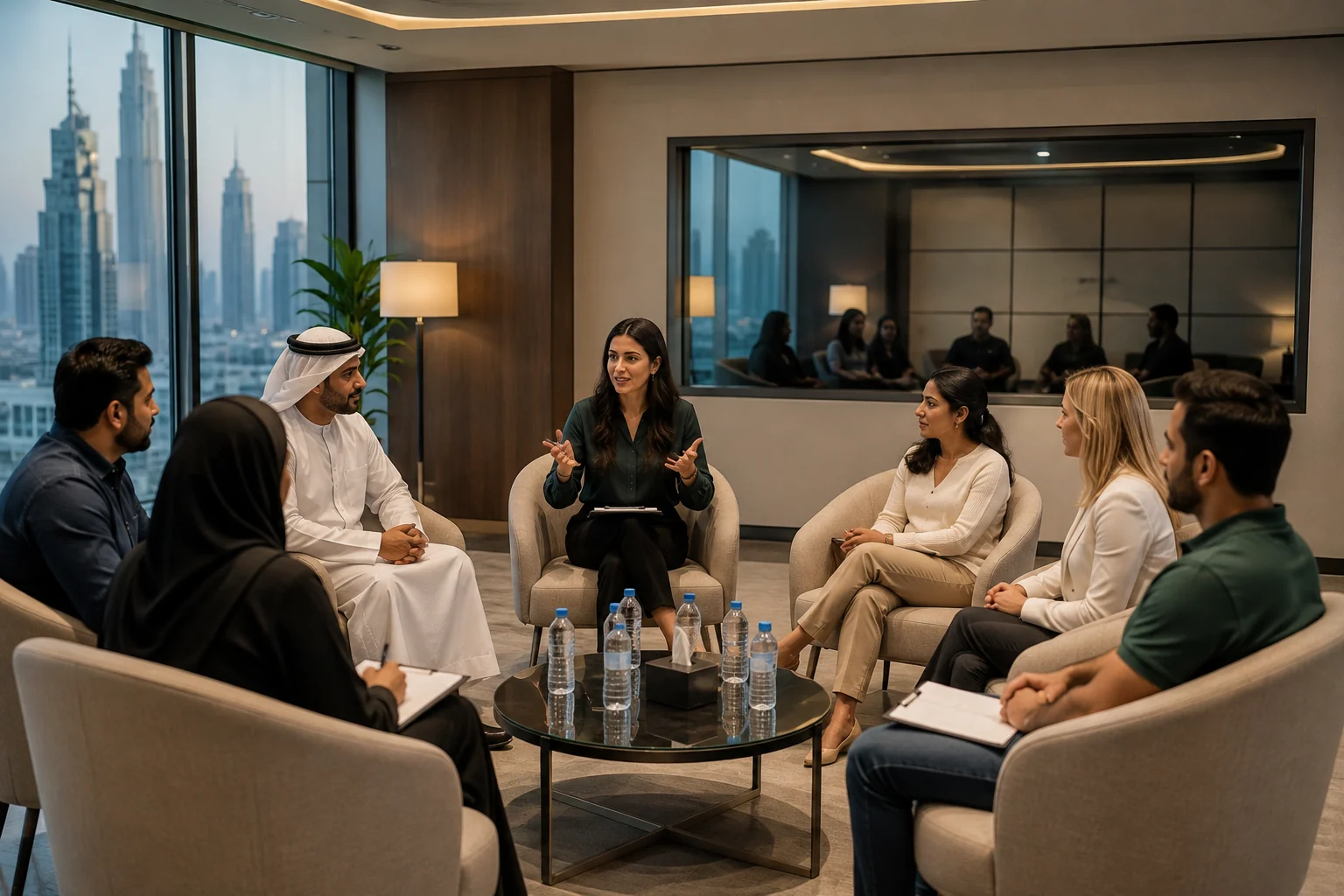
Focus Groups Remain One of the Most Powerful Ways to Understand Consumers
Focus groups in Dubai give businesses and research agencies an opportunity to explore what consumers think, feel and experience in considerably greater depth than a structured survey alone can usually provide.
Instead of limiting participants to predetermined answer options, a focus group allows an experienced moderator to explore opinions, motivations, expectations, frustrations, purchase decisions and reactions through an interactive discussion.
Dubai is particularly valuable for qualitative market research because of its diverse consumer population, international business environment and access to respondents from different demographic, cultural and professional backgrounds.
However, successful focus group research requires much more than bringing several people into a room and asking questions. Participant recruitment, screening, group composition, moderation, facilities, incentives, scheduling and quality control can all influence the usefulness of the final insights.
This guide explains how focus groups in Dubai work, from research design and respondent recruitment to facilities, moderation, incentives and fieldwork quality.
Qualitative Research
What Is a Focus Group?
A focus group discussion, commonly known as an FGD, is a qualitative research method in which a small number of carefully selected participants discuss a particular subject under the guidance of a moderator.
Rather than measuring how many people hold a particular opinion, focus groups help researchers understand why people think or behave in certain ways.
Participants can explain their experiences in their own words, respond to concepts or products and react to the opinions expressed by other members of the group.
This interaction is one of the defining strengths of focus group research. A participant may introduce an experience that encourages others to remember similar situations, challenge an assumption or explain why their own behaviour is different.
The moderator then explores these reactions to identify patterns, differences and underlying motivations.
Understand attitudes, motivations, experiences and perceptions that cannot always be captured through closed-ended questions.
Ask follow-up questions when participants reveal important opinions, behaviours or unexpected experiences.
Examine how participants react to concepts, products, messages and the opinions expressed by other group members.
What Are Focus Groups Used for in Market Research?
Focus groups can be used at different stages of the research and decision-making process.
Businesses may conduct groups before launching a product to understand unmet needs, during concept development to evaluate alternative ideas or after launch to investigate customer reactions and experiences.
They are also commonly used for advertising research, brand positioning, customer experience, product testing, packaging evaluation and purchase journey research.
Because the method is exploratory, focus groups can also reveal issues that researchers did not initially expect.
Dubai Market
Why Conduct Focus Groups in Dubai?
Dubai is one of the UAE's most important markets for qualitative research because businesses can access consumers and professionals from a wide variety of backgrounds within one city.
Depending on the research objective, focus groups can involve UAE nationals, Arab expatriates, South Asian consumers, Western expatriates, professionals, parents, vehicle owners, customers or other carefully defined audiences.
This diversity creates valuable research opportunities, but it also means researchers should think carefully about group composition.
Combining participants from very different backgrounds into one discussion is not always appropriate. Language, category behaviour, income, age, nationality or customer status may influence how comfortable participants feel and how relevant their experiences are to one another.
For broader information about research execution in the city, see our market research company in Dubai page.
Dubai's Diversity Makes Group Composition Important
A focus group works best when participants have enough shared context to discuss the research topic meaningfully while still bringing different experiences and opinions into the conversation.
This does not mean everyone in the group should be identical. Some variation is useful because disagreement can reveal important differences in attitudes and behaviour.
However, large differences in language, social context or category experience can sometimes prevent the discussion from developing naturally.
Researchers should therefore decide which characteristics need to be controlled within each group and which can be allowed to vary.
The Best Participants Are Not Always the Best Group
Every respondent may qualify individually while the combination of participants is still unsuitable for a productive discussion.
Shared Relevance
Participants should have sufficient common experience with the category or research topic to contribute meaningfully.
Useful Differences
Differences in attitudes and experiences can generate valuable discussion when they are relevant to the research.
Comfortable Interaction
Group composition should allow participants to express opinions openly without unnecessary barriers to discussion.
Participant Recruitment
Focus Group Recruitment in Dubai
Participant recruitment is one of the most important stages of focus group research.
A respondent should not be recruited simply because they are available and willing to attend. They must genuinely match the demographic, behavioural or category-specific criteria defined by the study.
Recruitment criteria may include age, gender, nationality, income, location, brand usage, product ownership, purchase frequency, customer status or future purchase intention.
Specialist studies may require additional criteria. Automotive groups could require owners of specific vehicle brands or models. Banking research may need users of particular financial products. FMCG groups may require regular category buyers rather than occasional users.
Census Market Research supports dedicated focus group participant recruitment for qualitative studies in the UAE.
Why Screening Is Critical for Focus Group Participants
Screening converts the target audience definition into a structured set of qualification questions.
A strong screener does more than confirm basic demographics. It determines whether the participant genuinely has the experience, behaviour or ownership required by the research.
For example, a study involving frequent food delivery app users may need to establish which platforms participants use, how recently they ordered and how often they place orders.
A vehicle owner study may need to establish make, model, purchase date and whether the participant personally influenced the purchase decision.
Qualification questions should be structured carefully so that the desired answers are not unnecessarily obvious.
How Many Participants Should Be in a Focus Group?
There is no universal group size suitable for every qualitative study.
Traditional focus groups often involve approximately six to eight participants, while mini-groups may use fewer participants when the subject requires deeper individual contribution or the target audience is particularly specialised.
The appropriate number depends on the research objective, participant profile, discussion length and the level of interaction required.
Larger groups can generate a wider range of perspectives, but they also give each participant less time to speak. Smaller groups can provide greater depth but may generate less interaction if participants are not engaged.
The group size should therefore be selected as part of the qualitative research design rather than treated as a fixed rule.
A Common Focus Group Range
Six to eight participants is frequently used for conventional consumer groups, but the final design should always reflect the research objective and audience.
Should Focus Groups Be Over-Recruited?
Qualitative projects sometimes recruit more participants than the minimum number required because cancellations and no-shows can occur.
However, over-recruitment should be planned rather than used as an excuse to invite an excessive number of participants into the final discussion.
The objective is to protect the research against attendance risk while maintaining the intended group size and composition.
Participants should also be reconfirmed before the session, particularly when they have been recruited several days in advance.
Research Facilities
Choosing a Focus Group Facility in Dubai
The research environment can influence both participant comfort and the client's ability to observe the discussion.
A professional focus group facility should provide a quiet and private setting where participants can speak comfortably without unnecessary interruptions.
Depending on the project, clients may also require observation capabilities, audio or video recording, live streaming, interpretation support or space for product and concept materials.
Location is another important consideration. A facility that is difficult for the target audience to reach can increase lateness and attendance problems.
Consider where participants are travelling from and whether the venue is practical for the target audience.
Participants need a professional, comfortable and private setting that supports open discussion.
Where required, observation or live viewing should allow the research team to follow the discussion without disrupting it.
Viewing Rooms and One-Way Mirrors
Some qualitative studies require clients or research teams to observe the discussion from a separate viewing area.
Traditional facilities may use a one-way mirror, while other projects use camera feeds or secure live streaming to allow remote stakeholders to observe.
The appropriate setup depends on client requirements, confidentiality considerations and the type of research being conducted.
Observation can be valuable because stakeholders hear participants explain experiences in their own words rather than receiving only a summary after fieldwork.
Online Focus Groups vs In-Person Focus Groups in Dubai
Focus groups do not always need to take place in a physical research facility.
Online focus groups can be useful when participants are geographically dispersed, scheduling is difficult or the research topic does not require physical interaction with products or materials.
In-person groups remain particularly useful when researchers want to observe physical reactions, test products, evaluate packaging, examine prototypes or create more natural group interaction.
Facility-Based Focus Groups
- Natural face-to-face interaction
- Physical product evaluation
- Packaging and concept testing
- Direct behavioural observation
- Client viewing options
- Controlled research environment
Online Focus Groups
- Remote participation
- Flexible geographic recruitment
- Reduced participant travel
- Convenient client observation
- Digital stimulus sharing
- Useful for suitable remote audiences
Moderation
Why the Focus Group Moderator Matters
The moderator is responsible for turning the research objectives into a productive conversation.
Good moderation is not simply reading questions from a discussion guide. The moderator needs to listen carefully, recognise important comments, probe for deeper explanations and ensure that the discussion remains relevant to the research objectives.
They must also manage group dynamics.
Some participants naturally speak more than others. A strong moderator encourages quieter respondents to contribute while preventing more dominant personalities from controlling the discussion.
At the same time, moderation should not become overly controlling. Participants need enough freedom to explain experiences in their own words and introduce perspectives the research team may not have anticipated.
Good Moderation Balances Structure With Discovery
Listen
Identify comments that reveal deeper motivations, frustrations, expectations or differences in behaviour.
Probe
Ask follow-up questions that help participants explain why they think, feel or behave in a particular way.
Balance
Give participants opportunities to contribute without allowing one person to dominate the discussion.
Arabic vs English Focus Group Moderation in Dubai
Language should be selected according to the target audience rather than client convenience.
Dubai research may require English, Arabic or another language depending on the participant profile.
Participants generally provide richer qualitative insight when they can express themselves comfortably. This is particularly important when discussing emotions, experiences, cultural attitudes or complicated purchase decisions.
If research includes audiences with different language preferences, separate groups may sometimes produce stronger insight than forcing every participant into one language.
Translation and interpretation requirements should therefore be considered during the initial research design.
Discussion Guide
How to Design a Strong Focus Group Discussion Guide
The discussion guide gives the moderator a structured framework for covering the research objectives while leaving enough flexibility to explore unexpected insights.
A good guide normally moves from broad and easy questions toward more detailed topics.
Participants may begin by discussing general category behaviour before moving into specific brands, experiences, concepts or evaluation exercises.
The guide should avoid trying to ask too many questions within the available session time. Qualitative research requires space for participants to explain their answers and for the moderator to probe.
Warm-Up
Help participants become comfortable speaking and introduce the general research topic naturally.
Current Behaviour
Explore existing experiences, habits, category usage and decision-making before introducing new concepts.
Deep Exploration
Investigate motivations, barriers, perceptions and the reasons behind participant behaviour.
Evaluation
Introduce products, concepts, communications or other research materials where required.
Qualitative Fieldwork
How Long Should a Focus Group Last?
Many focus group discussions run for approximately 60 to 120 minutes, depending on the research objectives and exercises involved.
The appropriate length should be determined by the amount of material that genuinely needs to be explored rather than automatically choosing the longest possible session.
Longer discussions can be appropriate when participants need to evaluate several concepts, products or complex experiences. However, participant concentration can decline if sessions become unnecessarily long.
The discussion guide should therefore be realistic about how much depth can be achieved within the available time.
Minutes of Qualitative Exploration
Many groups fall within this range, although the final duration should reflect the audience, objectives and research exercises.
Participant Experience
Focus Group Incentives in Dubai
Participants are commonly offered an incentive to compensate them for the time and effort required to attend a focus group.
The appropriate incentive depends on the participant profile, session length, recruitment difficulty, location and level of commitment required.
A general consumer and a senior business decision-maker should not automatically receive the same incentive because their availability and recruitment difficulty may be very different.
Incentives should be established during recruitment planning so participants understand the arrangement before confirming attendance.
Screening comes first; participation and compensation follow.
Fieldwork Quality
Quality Control for Focus Groups in Dubai
Qualitative quality control begins during recruitment rather than when the moderator enters the room.
Participant eligibility should be checked against the agreed screener, important criteria should be verified where appropriate and attendance should be reconfirmed before the session.
During the group, the moderator should ensure that every participant contributes meaningfully and that discussion remains connected to the research objectives.
Recording, observation and fieldwork documentation should also be managed according to the agreed project requirements and participant consent.
Quality Must Be Protected at Every Stage
Before
Screen, verify, schedule and reconfirm participants against the agreed recruitment criteria.
During
Manage group dynamics, follow the research objectives and create space for meaningful participant contribution.
After
Protect recordings and research materials and provide the agreed fieldwork outputs for analysis and reporting.
Focus Groups vs In-Depth Interviews
Focus groups are not automatically the best qualitative method for every project.
In-depth interviews can be more appropriate when the topic is sensitive, the audience is highly specialised or individual decision-making needs to be explored without influence from other participants.
Focus groups are particularly useful when interaction between participants can reveal shared experiences, disagreements and different perspectives.
Some research programmes use both methods: focus groups to explore broader consumer themes and individual interviews to investigate specialist or sensitive topics in greater depth.
Census Market Research supports both focus group discussions and in-depth interviews for qualitative research projects.
Focus Groups
- Interactive group discussion
- Comparison of different opinions
- Useful for concepts and brands
- Participant-to-participant reactions
- Strong exploratory method
In-Depth Interviews
- Individual conversation
- Greater personal depth
- Suitable for sensitive subjects
- Useful for specialist audiences
- No group influence
“Great focus group research is not simply about gathering people in a room. It is about recruiting the right participants, creating the right environment and asking the right questions to uncover the reasons behind their decisions.”
Industry Applications
What Types of Focus Groups Can Be Conducted in Dubai?
Focus groups can support research across many industries in Dubai because the method can be adapted to different audiences, products and business questions.
Consumer brands may use groups to explore shopping behaviour, product preferences and communication. Automotive companies may investigate vehicle ownership and purchase decisions. Financial institutions can explore customer expectations, while technology companies can evaluate digital experiences and new service concepts.
The important consideration is not simply the industry. Researchers need to identify which participants have the experience necessary to answer the business question.
This is why recruitment criteria, discussion design and moderation should change according to the category being researched.
Automotive Research
Automotive Focus Groups in Dubai
Dubai's large and varied automotive market makes focus groups particularly useful for understanding vehicle owners, intenders and different automotive customer segments.
Research may explore why consumers selected a particular brand, what alternatives they considered, which vehicle features matter most, how ownership experiences influence loyalty and what could encourage them to switch brands.
Automotive groups can also support concept evaluation, new model research, after-sales research, dealership experience studies and broader understanding of the vehicle purchase journey.
Recruitment needs to reflect the exact objective. A study may require owners of particular makes and models, SUV owners, premium vehicle customers, recent purchasers or consumers intending to buy within a specified period.
Where ownership is central to eligibility, appropriate verification can strengthen participant quality.
Our automotive owner recruitment services can support projects requiring specific vehicle profiles.
From Vehicle Choice to Ownership Experience
Purchase Journey
Explore triggers, consideration sets, dealer interactions and the factors that ultimately influence vehicle selection.
Product Experience
Understand reactions to vehicle design, technology, comfort, performance, features and everyday usability.
Brand Perception
Investigate how consumers perceive automotive brands and what influences trust, loyalty or switching behaviour.
FMCG & Product Research
FMCG Focus Groups and Product Testing in Dubai
Focus groups are widely used in FMCG research because consumers can explain not only which products they buy but why particular brands, formats, flavours, packaging or propositions appeal to them.
Researchers can explore category habits before introducing a new concept or product, helping distinguish existing behaviour from reactions created by the research stimulus itself.
Where physical products are involved, participants may evaluate appearance, packaging, functionality, taste, fragrance, texture or other relevant characteristics depending on the category.
Product exposure should be carefully controlled so every participant receives comparable materials and instructions.
For studies requiring structured product evaluation alongside qualitative exploration, our product testing services can support broader research programmes.
Concept Testing
Using Focus Groups for Concept and Communication Testing
Businesses often need consumer feedback before investing heavily in a new product, service, campaign or proposition.
Focus groups allow researchers to present concepts and explore participants' immediate reactions, understanding, perceived relevance and concerns.
The moderator can investigate which elements attract attention, which create confusion and whether the intended message is being interpreted correctly.
Researchers should be careful not to ask only whether participants “like” a concept. Preference alone rarely explains whether an idea has genuine market potential.
More useful discussion explores relevance, credibility, differentiation, expected benefits, barriers and potential influence on future behaviour.
Explore whether the proposition and intended benefits are immediately clear or require further explanation.
Understand whether the concept addresses something meaningful within the participant's existing behaviour or experience.
Investigate how participants compare the idea with products, services or brands already available to them.
B2B Qualitative Research
Can Focus Groups Be Used for B2B Research in Dubai?
Yes, although B2B qualitative research needs to be designed around the seniority and professional characteristics of the participants.
Some business audiences can contribute effectively in a group environment, particularly when participants share similar responsibilities and the research topic is suitable for open professional discussion.
However, in-depth interviews may be more appropriate for very senior executives, highly specialised professionals, commercially sensitive subjects or situations where participants could be uncomfortable discussing business practices in front of peers.
The decision between an FGD and an IDI should therefore depend on the research objective rather than simply the number of interviews required.
Specialist professional audiences can be sourced through our B2B respondent recruitment services.
When confidentiality, seniority or specialist knowledge limits useful group interaction, an in-depth interview may produce stronger insight.
Research Planning
How Many Focus Groups Does a Research Project Need?
The number of focus groups should be determined by the research objectives and the audience segments that need to be compared.
If a project needs to understand substantially different consumer groups, researchers may need separate discussions for those audiences.
For example, a study could separate current customers from competitor customers, younger consumers from older consumers or different nationality and language groups where those distinctions are strategically important.
Running only one group can sometimes make it difficult to determine whether an observation represents a broader pattern or simply the dynamics of that individual session.
Additional groups allow researchers to compare discussions and identify themes that appear consistently across participants and segments.
One Group Should Not Automatically Represent an Entire Market
Qualitative research is designed for depth rather than statistical representation. Multiple groups can help researchers compare important audience segments and recurring themes.
Should Dubai and Abu Dhabi Be Researched Separately?
Whether Dubai and Abu Dhabi require separate focus groups depends on the research question and whether geography is expected to influence behaviour or experience.
For some categories, combining participants may be reasonable. For others, separate groups can help researchers understand differences in consumer profile, lifestyle, industry exposure or local market experience.
Researchers should not assume that participants from one city automatically represent the entire UAE.
Our Dubai vs Abu Dhabi market research guide explains when geographic differences may matter to research design.
Project Timeline
How Long Does a Focus Group Project Take in Dubai?
The timeline depends on the complexity of the target audience, number of groups, screening requirements, facility arrangements, moderation language and required outputs.
Recruitment is often one of the most important variables. Broad consumer audiences may be sourced relatively efficiently, while low-incidence consumers, senior professionals or highly specialised participants can require additional time.
The process may include questionnaire or screener finalisation, recruitment, participant verification, scheduling, facility preparation, moderation, recordings, transcription, translation and delivery of fieldwork materials.
Research buyers should therefore allow enough time for quality recruitment rather than compressing the schedule simply to reach the discussion date faster.
Focus Group Costs
How Much Do Focus Groups Cost in Dubai?
There is no single fixed cost for conducting a focus group in Dubai because the total depends on the research design.
Recruitment is influenced by the incidence and complexity of the target audience. Participant incentives vary according to respondent profile and session requirements. Facility, moderation, interpretation, recording, transcription and project management can also affect the final budget.
A group involving general consumers will therefore have a different cost structure from research requiring senior business decision-makers or owners of a rare product.
When comparing quotations, clients should check exactly which services are included rather than comparing only one headline price.
Common Mistakes
Common Focus Group Research Mistakes to Avoid
Weak Participant Screening
Recruiting participants who only partially match the target profile can weaken the entire qualitative discussion.
Poor Group Composition
Individually qualified respondents may still create an ineffective group if important audience differences are not considered.
Too Many Questions
Overloading the discussion guide reduces the time available to probe the issues that require genuine qualitative depth.
Leading Participants
Questions that reveal the desired answer can influence participants and reduce the independence of their responses.
Dominant Respondents
Allowing one or two participants to control the conversation can prevent quieter group members from contributing.
Treating Findings as Statistics
Focus groups provide qualitative depth and explanation; they should not automatically be interpreted as statistically representative results.
Research Quality
How to Improve the Quality of Focus Group Research
Strong qualitative research requires alignment between the business question, respondent profile, methodology and discussion guide.
Recruitment should begin only after the target audience has been clearly defined. The screener should then translate those requirements into practical qualification criteria.
Participants should be reconfirmed before the session, the moderator should understand the research objectives and the facility or online platform should be prepared before fieldwork begins.
During the discussion, researchers should pay attention not only to what participants say but also to why opinions differ and which experiences appear consistently across groups.
Six Elements of a Strong Focus Group Project
1. Objective
Define exactly what the research needs to understand before selecting the audience or methodology.
2. Recruitment
Source participants who genuinely match the demographic, behavioural or professional criteria.
3. Screening
Use carefully designed questions to establish eligibility and verify important requirements where appropriate.
4. Environment
Create a comfortable research setting where participants can communicate openly and naturally.
5. Moderation
Balance the discussion, probe important comments and keep the conversation connected to the research objectives.
6. Interpretation
Identify recurring themes, meaningful differences and the reasons behind participant attitudes and behaviour.
Choosing a Research Partner
How to Choose a Focus Group Company in Dubai
Businesses and international research agencies should evaluate a qualitative fieldwork partner based on more than facility availability.
Recruitment capability is particularly important because even an excellent moderator cannot compensate for incorrectly recruited participants.
The research partner should understand the target audience, expected incidence, screening criteria, group composition, language requirements and fieldwork logistics before confirming feasibility.
Researchers should also establish who will manage participant confirmation, incentives, venue arrangements, recordings and other project requirements.
Understand the proposed sourcing strategy and whether it is suitable for the target audience.
Review the screening and verification approach before recruitment begins.
Clarify responsibility for recruitment, confirmations, facility coordination, moderation and research outputs.
Working With a Local Dubai Fieldwork Partner
International research agencies often manage research design, analysis and client relationships centrally while working with a local fieldwork partner for execution in Dubai.
A local partner can support participant recruitment, screening, venue coordination, moderation, incentives, fieldwork supervision and other operational requirements according to the project scope.
This model works particularly well when responsibilities and quality expectations are clearly agreed before recruitment begins.
For projects extending beyond qualitative research, Census Market Research also supports broader market research services across the UAE.
Frequently Asked Questions
Frequently Asked Questions About Focus Groups in Dubai
A focus group is a moderated qualitative discussion with a small number of carefully selected participants used to explore attitudes, experiences, motivations and reactions in depth.
Many conventional groups include approximately six to eight participants, although smaller or larger formats may be appropriate depending on the research objective and audience.
Many sessions last approximately 60 to 120 minutes. The appropriate duration depends on the discussion guide, audience and research exercises.
Yes. The moderation language should reflect the participant profile so respondents can communicate naturally and provide detailed answers.
Yes. Online focus groups can be effective when remote participation is appropriate, while in-person groups may be preferable for physical product testing or direct observation.
Participants are recruited and screened according to project-specific demographic, behavioural, professional or category criteria before being invited to the session.
Incentives are commonly provided to compensate participants for their time. The amount depends on the respondent profile, session duration and recruitment difficulty.
Focus groups use interaction between several participants, while an in-depth interview is an individual conversation that can provide greater personal depth or suit more sensitive and specialised subjects.
Yes, when the topic and participant profiles are appropriate for group discussion. For highly senior or specialist audiences, individual interviews may sometimes be more suitable.
Census Market Research
Focus Group Research and Recruitment in Dubai
Census Market Research supports businesses, consulting firms and international research agencies conducting qualitative market research in Dubai and across the UAE.
Depending on the project scope, support can include respondent recruitment, participant screening, scheduling, facility coordination, moderation and qualitative fieldwork management.
Projects can involve general consumers as well as more specialised audiences such as customers, vehicle owners, business decision-makers and other project-specific respondent profiles.
Our qualitative research services provide additional information about our broader qualitative capabilities.
Final Perspective
Successful Focus Groups Begin With the Right Research Design
Focus groups can provide powerful insight into how people think, what influences their decisions and why their experiences differ.
Their value, however, depends on the quality of the entire research process.
The target audience needs to be clearly defined. Participants need to be carefully recruited and screened. Group composition should support productive discussion, and the research environment should allow respondents to communicate comfortably.
The moderator then needs to go beyond simply asking questions. Strong qualitative moderation listens for important themes, explores contradictions, encourages quieter participants and investigates the reasons behind behaviour.
When recruitment, facilities, moderation and fieldwork quality are properly aligned, focus groups in Dubai can help businesses move beyond surface-level answers and understand the human reasons behind consumer and customer decisions.
Discuss Your Qualitative Research Project With Our Team
Census Market Research supports focus group recruitment and qualitative fieldwork for consumer, B2B and specialist research projects in Dubai and across the UAE.
Share your target audience, number of groups, screening criteria, preferred language, session duration and fieldwork requirements to discuss feasibility and the appropriate research approach.
Discuss Your Focus Group Project