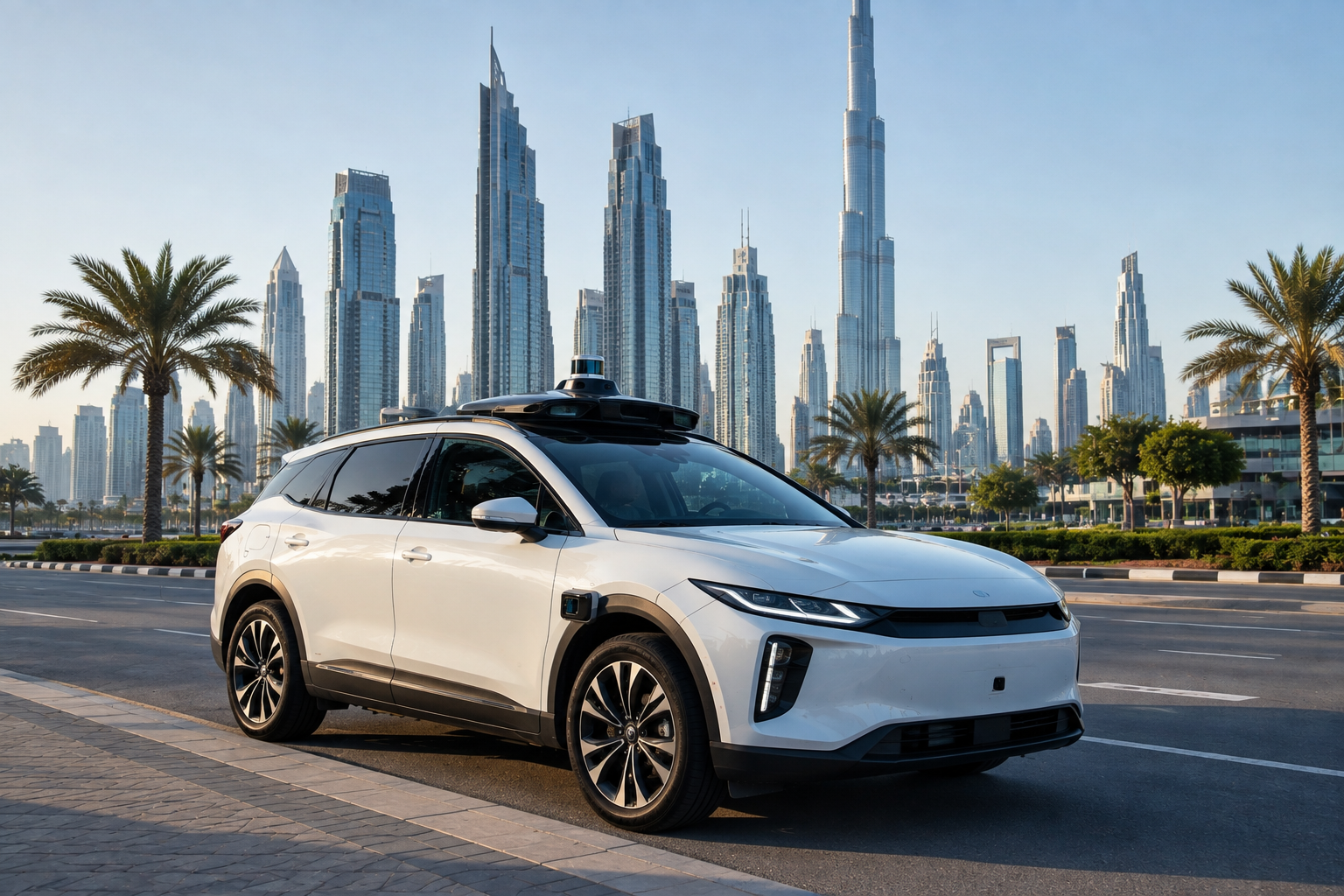
Would You Trust a Driverless Taxi in Dubai?
Imagine stepping out of a hotel, shopping mall or office in Dubai and requesting a taxi through your phone.
A few minutes later, the vehicle arrives. You open the door, sit down and confirm your destination.
For decades, this scene belonged to science fiction. Today, autonomous mobility is moving closer to becoming part of everyday urban transportation.
Dubai's continued development of autonomous mobility represents another important step in the city's broader ambition to embrace smart transportation and future-focused technologies.
Are Consumers Ready to Trust Them?
Engineers, technology companies and transport authorities can focus on whether autonomous vehicles can safely navigate roads, understand traffic and respond to complex environments.
But successful adoption depends on something technology alone cannot decide:
Will people feel comfortable handing control of their journey to a machine?
Can the vehicle do it?
- Sensors
- Cameras
- Artificial Intelligence
- Navigation Systems
- Real-Time Decision-Making
Will people trust it?
- Perceived Safety
- Confidence
- Control
- Privacy
- Willingness to Adopt
The Questions Consumers Will Need to Answer
Autonomous mobility creates a fascinating new area for consumer research in the UAE .
The most important questions may have less to do with engineering and more to do with human behaviour.
How comfortable would passengers feel without a human driver present?
Would attitudes change when children, parents or other family members are involved?
Would one successful journey significantly increase willingness to use the service again?
Would consumers expect driverless taxis to be cheaper than conventional taxis?
Could some passengers value the privacy of travelling without a driver?
Which consumer groups are most likely to try autonomous mobility early?
Not Every Consumer Will Respond the Same Way
The answers are unlikely to be identical across Dubai's population.
Attitudes toward autonomous mobility could vary significantly according to:
A technology enthusiast may be excited to try a driverless taxi immediately. Another passenger may prefer to wait until autonomous vehicles have become familiar and widely used.
A tourist visiting Dubai may view the experience as something innovative and memorable, while a resident using taxis every day may judge the service primarily on reliability, convenience and price.
A Real-World Environment for Understanding Technology Adoption
Dubai brings together residents and visitors from many different cultural and demographic backgrounds, alongside widespread use of digital services and continued investment in smart mobility.
This creates an interesting environment for studying how people respond when advanced technologies move from demonstrations and pilot programmes into everyday life.
Why Consumer Trust Matters for Businesses
For organizations involved in mobility, automotive, technology, insurance and transportation, understanding consumer adoption could become just as important as understanding the technology itself.
Market Research Can Help Explain Adoption
At Census Market Research , we see developments such as autonomous mobility as more than technology stories.
They create opportunities to understand how consumer attitudes, expectations and behaviours change when innovation moves from concept to everyday experience.
Through automotive market research in the UAE , qualitative research, quantitative surveys and consumer research, organizations can investigate the factors that influence:
- Initial Awareness
- Perceived Safety
- Trust in Autonomous Technology
- Willingness to Trial
- Price Expectations
- Privacy Perceptions
- First-Journey Experience
- Repeat Usage
- Long-Term Adoption
The real question is not simply whether consumers say they would use autonomous mobility — but what actually drives trial, trust, adoption and repeat usage.
The technology may be driverless, but understanding the people inside it will still require human insight.
What Will Make Consumers Adopt Driverless Taxis?
The arrival of autonomous taxis in Dubai raises a question that goes far beyond whether the technology works.
What will make people actually choose a driverless taxi?
Technology can be tested, improved and validated. Vehicles can use cameras, sensors, artificial intelligence and sophisticated mapping systems to understand their surroundings.
But consumer acceptance follows a different journey.
Online banking, digital payments, ride-hailing applications and online shopping all faced questions around security, reliability and trust before becoming part of everyday behaviour.
Autonomous transportation may follow a similar path.
Safety May Be the First Barrier
For many consumers, safety is likely to be one of the first considerations.
A passenger may wonder:
But perceived safety and actual safety are not necessarily the same thing.
Even when technology demonstrates strong safety performance, some consumers may still feel uncomfortable because they are giving up direct human control.
This creates an important opportunity for qualitative research in the UAE .
In-depth interviews and focus groups can help researchers understand the emotions behind hesitation. Rather than simply measuring whether someone trusts autonomous vehicles, research can explore why they trust or distrust them.
Sometimes the most important barrier to adoption is not technical. It is emotional.
Would Price Change Your Decision?
Imagine two taxis are available for exactly the same journey.
Human-Driven Taxi
AED 50Autonomous Taxi
AED 50Which one would you choose?
Now change the conditions.
Would any of these benefits change the decision?
These trade-offs are especially interesting from a quantitative research perspective.
Rather than asking only whether consumers like autonomous taxis, researchers can test how price, waiting time, perceived safety, vehicle type, privacy and convenience influence actual preference.
The First Journey Could Change Everything
One of the most interesting research opportunities may be studying consumers immediately before and after their first autonomous taxi experience.
Expectations
- Perceived Safety
- Trust in Autonomous Technology
- Anxiety
- Expected Comfort
- Willingness to Use
- Willingness to Recommend
Real Experience
- Experienced Safety
- Actual Trust
- Comfort Level
- Experience Quality
- Repeat Usage Intention
- Recommendation Intention
Imagine a passenger rating their trust in autonomous taxis 4 out of 10 before the journey and 9 out of 10 afterward.
That change would tell researchers something extremely valuable.
Alternatively, if trust remained low even after a successful journey, research could explore what aspects of the experience continued to create concern.
Experience-based studies could combine surveys, interviews, observation and CAPI data collection to capture reactions while the experience is still fresh.
Dubai's Diversity Makes the Question Even More Interesting
Dubai brings together people from different cultural, demographic and professional backgrounds.
That means autonomous mobility adoption is unlikely to follow one simple pattern.
Nationality, income, family status, travel frequency and previous technology experience could all potentially influence adoption.
The objective of market research in the UAE should therefore not be to assume how different groups will behave.
From Curiosity to Everyday Behaviour
New technologies often move through a series of behavioural stages before becoming part of everyday life.
People first become familiar with the technology.
Interest grows as people learn more about the experience.
Early users decide to experience the service themselves.
Successful experiences begin to reduce uncertainty.
The service becomes a realistic mobility choice.
The technology becomes part of normal everyday behaviour.
The most important moment may not be when someone tries an autonomous taxi for the first time.
It may be when passengers stop thinking about the fact that the taxi is autonomous at all.
What Should Mobility & Automotive Companies Be Measuring?
Autonomous transportation creates a new set of consumer questions for automotive manufacturers, mobility platforms, technology companies, insurers, government organizations and investors.
What turns a first-time user into a repeat customer?
These are not purely technology questions.
Understanding the Consumer Behind Autonomous Mobility
As Dubai continues adopting advanced mobility solutions, organizations will increasingly need to understand not only how the technology performs but how consumers respond to it.
This creates opportunities for automotive market research , consumer surveys, focus groups, in-depth interviews, observational studies and real-world experience research.
At Census Market Research , our role is to help organizations understand these behavioural changes through qualitative and quantitative research across the UAE and wider GCC.
As autonomous mobility becomes increasingly visible in Dubai, understanding the human side of adoption could become one of the most interesting consumer research questions of the coming years.
